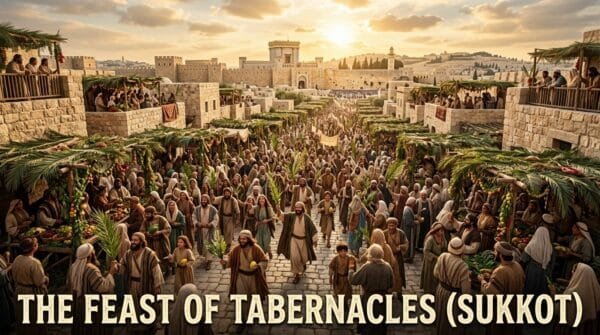
The Feast of Tabernacles (Sukkot)
Executive Summary:
This chapter explains how Scripture says to keep the Feast of Sukkot (Tabernacles), as well as some of the future prophetic implications. For the Ancient Hebrew Wedding model, please see our study on The Feasts of the Seventh Month. (We hope to include the Ancient Hebrew Wedding model into this study when we put it into its second edition).
Lesson Plan:
As we show in The Feasts of the Seventh Month, the feasts are like dates with our Husband (Yeshua). For that reason, it is important to be where He says to be, when He says to be there, doing the things He says to do. To be good brides to the King, we need to follow His instructions closely. That is why we will ground ourselves in the technical details here, so that we can be sure to please Him in the day of Judgment.
1. What do sukkot represent?
2. A time to rejoice and give back.
3. The timing and commands of the feast.
4. Yahweh’s four species? Or the rabbinic five?
5. The Torah reading in the sabbatical years.
6. Nisuch HaMayim (the Pouring of the Water).
7. Future prophetic implications of Sukkot.
8. The time of our joy.
What do Sukkot Represent?
In the chapter on Hanukkah we discuss why Yeshua was probably born on the first day of the Feast of Tabernacles, otherwise known as the Feast of Booths, or Sukkot. But why does Yahweh command us to hold the Feast of Sukkot? What is the significance? What are we to learn from it?
In Hebraic thought, a sukka is different than a tent. In ancient times, tents were typically larger structures that families could live in, which were oftentimes moved on carts with donkeys, or with camels. In contrast, the Hebrew word for a tent is an ‘oh-hel’ (אֹהֶל), while the word for a tabernacle or a booth is ‘sukka’ (סֻכָּה). The plural of sukka is sukkot (סֻּכֹּת).
But what do sukkot represent? We find sukkot in Scripture whenever Yahweh’s people have just escaped from some grave and intense danger. For example, after Esau came out with four hundred men to kill Jacob, and Yahweh delivered Jacob from the crisis, Jacob then journeyed to a place called Sukkot, where he then built sukkot for his livestock.
| B’reisheet (Genesis) 33:17 17 And Jacob journeyed to Succoth, built himself a house, and made booths for his livestock. Therefore the name of the place is called Sukkot. |
וְיַעֲקֹב נָסַע סֻכֹּתָה וַיִּבֶן לוֹ בָּיִת | וּלְמִקְנֵהוּ עָשָׂה סֻכֹּת עַל כֵּן קָרָא שֵׁם הַמָּקוֹם סֻכּוֹת |
Sukkot are also a place of freedom. For example, when Pharaoh finally let the children of Israel go after the plague on the firstborn and they were driven out of Egypt, they went to a place called Sukkot.
Shemote (Exodus) 12:36-38
36 And Yahweh had given the people favor in the sight of the Egyptians, so that they granted them what they requested. Thus they plundered the Egyptians.
37 Then the children of Israel journeyed from Rameses to Sukkot, about six hundred thousand men on foot, besides children.
38 A mixed multitude went up with them also, and flocks and herds — a great deal of livestock.
According to Jewish tradition, a sukka is a rather flimsy structure. This is meant to symbolize how, when the children of Israel had just left Egypt, they were basically unarmed, unprotected, and vulnerable to the elements.
Even though the flimsy structures they built gave hardly any protection from the elements, it acknowledges that safety and security do not ultimately come from thick walls, fortifications, armies, gold, silver, or securities. Safety does not come from alliances, but only from the hand of Yahweh.
When Yahweh is with us, even a weak shelter can give us sufficient protection from heat, cold, and enemies. However, if Yahweh is against us, no shelter can protect us, no matter how sturdily it is built, or how well it is defended. This may be one reason why Yahweh has us dwell in sukkot every year, so we remember that our lives depend on Him, and His will.
In rabbinic thought, Israel enters mortal danger each year during the feast season of the seventh month. In rabbinical thought, Yom Teruah symbolizes divine judgment, and Yom Kippur is also a time of judgment. After these times of danger, Israel then dwells in sukkot, which are places of safety and freedom. In rabbinic thought, this is also one reason why Yahweh tells us that the Feast of Sukkot is to be a time of rejoicing at the many blessings that Yahweh has given us.
A Time to Rejoice and Give Back
When we live in the land this is also when we are to give back our three tithes (plus gifts, plus offerings) to help our Husband’s kingdom grow. As we explain elsewhere, in the Dispersion an argument can be made for a single tithe, but we still need to set aside money to make the feasts a delight for ourselves and our families, and we also need to give to the poor. These are a constant, and the three tithe system speaks directly to these needs of the body (our nation):
For example, Devarim 16 :14 speaks of the first tithe (to support the priesthood). It also speaks to the second tithe (for your family), and the third tithe (for the poor, two years in seven). This is because we are not just trying to learn what the Torah says—rather we are trying to carry it out.
In other words, we are trying to build an actual nation, and as such it needs actual funding and support from each and every one of us. We should give these gifts not as a checklist, but with joy, as a wife gives gifts to her Husband, who has redeemed her from bondage.
Devarim (Deuteronomy) 16:13-17
13 “You shall observe the Feast of Tabernacles seven days, when you have gathered from your threshing floor and from your winepress.
14 And you shall rejoice in your feast, you and your son and your daughter, your male servant and your female servant and the Levite, the stranger and the fatherless and the widow, who are within your gates.
15 Seven days you shall keep a sacred feast to Yahweh your Elohim in the place which Yahweh chooses, because Yahweh your Elohim will bless you in all your produce and in all the work of your hands, so that you surely rejoice.
16 “Three times a year all your males shall appear before Yahweh your Elohim in the place which He chooses: at the Feast of Unleavened Bread, at the Feast of Weeks, and at the Feast of Tabernacles; and they shall not appear before Yahweh empty-handed.
17 Every man shall give as he is able, according to the blessing of Yahweh your Elohim which He has given you.
The Timing and Commands of the Feast
The Feast of Sukkot is often thought of as being eight days long. However, it is technically a seven-day feast of Sukkot (Tabernacles, Booths) followed immediately by a full one-day feast called Shemini Atzeret, which means ‘The Eighth Day Assembly’, or ‘The Last Great Day.’
The two are easily confused because (like with Pesach and Unleavened Bread) the two feasts run together, and are often referenced together. Where Yahweh says “seven days” he means the Feast of Sukkot only, and where He references an eighth day he is referring to Shemini Atzeret (which we will cover in the next chapter).
Vayiqra (Leviticus) 23:33-38
33 Then Yahweh spoke to Moshe, saying,
34 “Speak to the children of Israel, saying: ‘The fifteenth day of this seventh month shall be the Feast of Tabernacles for seven days to Yahweh.
35 On the first day there shall be a set-apart gathering. You shall do no customary work on it.
36 For seven days you shall offer an offering made by fire to Yahweh. On the eighth day you shall have a set-apart gathering, and you shall offer an offering made by fire to Yahweh. It is a set-apart assembly, and you shall do no customary work on it.
37 ‘These are the feasts of Yahweh which you shall proclaim to be set-apart gatherings, to offer an offering made by fire to Yahweh, a burnt offering and a grain offering, a sacrifice and drink offerings, everything on its day,
38 besides the Sabbaths of Yahweh, besides your gifts, besides all your vows, and besides all your freewill offerings which you give to Yahweh.”
Then in the next five verses, Yahweh again tells us how He wants His feast celebrated, using different terms.
Vayiqra (Leviticus) 23:39
39 ” ‘Also on the fifteenth day of the seventh month, when you have gathered in the fruit of the land, you shall keep the feast of Yahweh for seven days; on the first day there shall be a sabbath-rest, and on the eighth day a sabbath-rest.”
In verse 40, Yahweh tells us to take four species of plants on the first day of the feast.
| Vayiqra (Leviticus) 23:40 40 And you shall take for yourselves on the first day the fruit of beautiful trees, branches of palm trees, the boughs of leafy trees, and willows of the brook; and you shall rejoice before Yahweh your Elohim for seven days. |
וּלְקַחְתֶּם לָכֶם בַּיּוֹם הָרִאשׁוֹן פְּרִי עֵץ הָדָר כַּפֹּת תְּמָרִים וַעֲנַף עֵץ עָבֹת וְעַרְבֵי נָחַל | וּשְׂמַחְתֶּם לִפְנֵי יְהוָה אֱלֹהֵיכֶם שִׁבְעַת יָמִים |
There is not universal agreement as to the identity of these plants. Rabbinic interpretation is that the fruit of beautiful trees, the branches of palm trees, the boughs of leafy trees and the willows of the brook are the etrog (citron, similar to a lemon), the lulav (palm branch), the myrtle, and the aravot (willow), respectively.
For those who want to follow the rabbinic interpretation, they may want to import the four rabbinically-identified species from the land of Israel. Others in the Dispersion may want to seek species that Yahweh has supplied locally.
Vayiqra (Leviticus) 23:41-44
41 “You shall keep it as a feast to Yahweh for seven days in the year. It shall be a statute forever in your generations. You shall celebrate it in the seventh month.
42 You shall dwell in booths for seven days. All who are native Israelites shall dwell in booths,
43 that your generations may know that I made the children of Israel dwell in booths when I brought them out of the land of Egypt: I am Yahweh your Elohim.'”
44 So Moshe declared to the children of Israel the feasts of Yahweh.
Yahweh’s Four Species? Or the Rabbinic Five?
A question arises about the discrepancies between the commandments in Nehemiah 8 and the commandments given in Torah. Nehemiah 8 records that when the children of Judah returned from the Exile to Babylon (under what might be called “pre-rabbinic leadership”), they adopted some traditions that deviate from the Torah.
Rather than simply rejoicing with the four species that Yahweh commands, they commanded five species (verse 15)—and only two of the species are the same! Further, they commanded that their sukkot be made out of them!
Nehemiah 8:13-18
13 Now on the second day the heads of the fathers’ houses of all the people, with the priests and Levites, were gathered to Ezra the scribe, in order to understand the words of the Torah.
14 And they found written in the Torah, which Yahweh had commanded by Moshe, that the children of Israel should dwell in sukkot during the feast of the seventh month,
15 and that they should announce and proclaim in all their cities and in Jerusalem, saying, “Go out to the mountain, and bring olive branches, branches of oil trees, myrtle branches, palm branches, and branches of leafy trees, to make booths , as it is written.”
16 Then the people went out and brought them and made themselves booths, each one on the roof of his house, or in their courtyards or the courts of the house of Elohim, and in the open square of the Water Gate and in the open square of the Gate of Ephraim.
17 So the whole assembly of those who had returned from the captivity made booths and sat under the booths; for since the days of Joshua the son of Nun until that day the children of Israel had not done so. And there was very great gladness.
18 Also day by day, from the first day until the last day, he read from the Book of the Torah of Elohim. And they kept the feast seven days; and on the eighth day there was a sacred assembly, according to the prescribed manner.
However, even though this error is recorded in Scripture, it is still an error, because Yahweh commands us not to add or take away from His words (e.g., Deuteronomy 4:2, 12:32).
The Torah Reading in the Sabbatical Years
Verse 18 tells us that Ezra read the entire Book of the Torah to the people during the Feast of Sukkot, in keeping with the command in Deuteronomy 31.
Devarim (Deuteronomy) 31:10-13
10 And Moshe commanded them, saying: “At the end of every seven years, at the appointed time in the year of release, at the Feast of Tabernacles,
11 when all Israel comes to appear before Yahweh your Elohim in the place which He chooses, you shall read this Torah before all Israel in their hearing.
12 Gather the people together, men and women and little ones, and the stranger who is within your gates, that they may hear and that they may learn to fear Yahweh your Elohim and carefully observe all the words of this Torah,
13 and that their children, who have not known it, may hear and learn to fear Yahweh your Elohim as long as you live in the land which you cross the Jordan to possess.”
The meaning of this passage is perennially debated. For one thing, that Ezra read from the Torah during the feast may indicate that they knew it was a sabbatical year. Alternately, it may also indicate that they did not know when the sabbatical year was, and since the children of Israel had not read from the Torah for many years, they chose to fulfill the commandment that year (to be safe). We really do not know.
For another thing, there is also an ongoing debate as to whether Yahweh meant to read the entire Torat Moshe, or only the book of Devarim / Deuteronomy. We do not know, but can only comment that this command was given before the establishment of the Torah portions (when Judah returned from the Exile to Babylon), and we recommend reading at least Deuteronomy.
Nisuch HaMayim (the Pouring of the Water)
On the last day of Sukkot there is a traditional water drawing ceremony called Nisuch HaMayim (נסוך המים), or the ‘pouring of the water.’ Nisuch HaMayim is not explicitly commanded in the Torah.
Rather, it is derived by traditional interpretation, and is therefore outside the scope of this study, because we do not believe in adding or taking away from Yahweh’s commandments in Torah (Deuteronomy 4:2, 12:32). However, that said, this ceremony is interesting because Yeshua tells us this feast is symbolic of Him.
Yochanan (John) 7:37-41
37 On the last day, that great day of the feast, Yeshua stood and cried out, saying, “If anyone thirsts, let him come to Me and drink.
38 He who believes in Me, as the Scripture has said, out of his heart will flow rivers of living water.”
39 But this He spoke concerning the Spirit, whom those believing in Him would receive; for the Set-apart Spirit was not yet given, because Yeshua was not yet glorified.
40 Therefore many from the crowd, when they heard this saying, said, “Truly this is the Prophet.”
41 Others said, “This is the Messiah.”
There are two different ways to interpret this. Some believe that since Yeshua says this feast represents Him, we should keep it. The logic for this is the same as with keeping Hanukkah, which is also not a commanded feast, and yet Yeshua said that Hanukkah represented Him. (Refer to the chapter, “Hanukkah Reconsidered“.)
Others believe that to add to Yahweh’s Torah commands is error, and they believe that Yeshua’s true meaning was that rather than focus on drawing water on the seventh day of the feast, to focus on Him. This is our position, as we believe what Scripture says about not adding to or taking away from His words.
Future Prophetic Implications of Sukkot.
As we saw earlier in this study, the feasts are prophetic shadow pictures of things still to come. This is also very true of Sukkot.
Zechariah 14 tells us that in the future, the nations of the world must come up to Jerusalem for the Feast of Tabernacles, or else they will have no rain.
Zechariah 14:16-19
16 And it shall come to pass that everyone who is left of all the nations which came against Jerusalem shall go up from year to year to worship the King, Yahweh of hosts, and to keep the Feast of Tabernacles.
17 And it shall be that whichever of the families of the earth do not come up to Jerusalem to worship the King, Yahweh of hosts, on them there will be no rain.
18 If the family of Egypt will not come up and enter in, they shall have no rain; they shall receive the plague with which Yahweh strikes the nations who do not come up to keep the Feast of Tabernacles.
19 This shall be the punishment of Egypt and the punishment of all the nations that do not come up to keep the Feast of Tabernacles.
Ezekiel 45 further tells us that in the future, the nasi (constitutional prince) of Israel will offer burnt offerings during the feast.
Yehezqel (Ezekiel) 45:25
25 “In the seventh month, on the fifteenth day of the month, at the feast, he [the prince] shall do likewise for seven days, according to the sin offering, the burnt offering, the grain offering, and the oil.”
We write elsewhere about the Tabernacle of David, to show that this is symbolic of the restoration of the lost house of Joseph. Yahweh plans to bring lost Joseph in through the Tree (Stick) of Joseph of Ezekiel 37, which is the Tabernacle of Joseph.
Ma’asei (Acts) 15:12-17
12 Then all the multitude kept silent and listened to Barnabas and Shaul declaring how many miracles and wonders Elohim had worked through them among the Gentiles.
13 And after they had become silent, Ya’akov answered, saying, “Men and brethren, listen to me:
14 Shimon has declared how Elohim at the first visited the Gentiles to take out of them a people for His name.
15 And with this the words of the prophets agree, just as it is written:
16 ‘After this I will return, and will rebuild the tabernacle of David, which has fallen down. I will rebuild its ruins, and I will set it up;
17 So that the rest of mankind may seek Yahweh, even all the Gentiles who are called by My name, says Yahweh who does all these things.’
Ya’akov (James) is quoting Amos 9:11, showing that Yahweh’s sukka is a protection for us. This same theme of Yahweh protecting us in His sukka is echoed in Isaiah Chapter Four.
Yeshayahu (Isaiah) 4:1-6
1 And in that day seven women shall take hold of one man, saying, “We will eat our own food and wear our own apparel, only let us be called by your name, to take away our reproach.”
2 In that day the Branch of Yahweh shall be beautiful and glorious, and the fruit of the earth shall be excellent and appealing for those of Israel who have escaped.
3 And it shall come to pass that he who is left in Tzion and remains in Jerusalem will be called set-apart — everyone who is recorded among the living in Jerusalem.
4 When Yahweh has washed away the filth of the daughters of Tzion, and purged the blood of Jerusalem from her midst, by the spirit of judgment and by the spirit of burning,
5 then Yahweh will create above every dwelling place of Mount Tzion, and above her assemblies, a cloud and smoke by day and the shining of a flaming fire by night. For over all the glory there will be a covering.
6 And there will be a tabernacle for shade in the daytime from the heat, for a place of refuge, and for a shelter from storm and rain.
We do not consider the Talmud to be inspired, but at least according to Talmud Tractate Succah 5:2, the priesthood lit four enormous golden candlesticks in the Court of Women within the Temple, during the Water Libation Ceremony (נסוך המים).
According to the Talmud, the wicks were made from old priestly garments, and the light was so bright that there was not a courtyard in all of Jerusalem that was not illuminated by its light during the feast. If true, then could it be that Yeshua said this light rightly referred to Him, seeing as the timing of Yochanan 8:12 is during the feast?
Yochanan (John) 8:12
12 Then Yeshua spoke to them again, saying, “I am the light of the world. He who follows Me shall not walk in darkness, but have the light of life.”
The Time of Our Joy
We will explain why Yeshua was probably born on the first day of Sukkot in the chapter on Hanukkah, but the following Scripture passages help to remind us that a major theme of the Feast of Sukkot is joy that a great Man-child was born.
Luqa (Luke) 2:6-11
6 So it was, that while they were there, the days were completed for her to be delivered.
7 And she brought forth her firstborn Son, and wrapped Him in swaddling cloths, and laid Him in a manger, because there was no room for them in the inn.
8 Now there were in the same country shepherds living out in the fields, keeping watch over their flock by night. 9 And behold, a messenger of Yahweh stood before them, and the glory of Yahweh shone around them, and they were greatly afraid.
10 Then the messenger said to them, “Do not be afraid, for behold, I bring you good tidings of great joy which will be to all people.
11 For there is born to you this day in the city of David a Savior, who is Mashiach Yahweh.
And:
Mattityahu (Matthew) 2:7-10
7 Then Herod, when he had secretly called the wise men, determined from them what time the star appeared.
8 And he sent them to Bethlehem and said, “Go and search carefully for the young Child, and when you have found Him, bring back word to me, that I may come and worship Him also.”
9 When they heard the king, they departed; and behold, the star which they had seen in the East went before them, till it came and stood over where the young Child was.
10 When they saw the star, they rejoiced with exceedingly great joy.
Further, in our study on The Feasts of the Seventh Month we can see that the Feast of Sukkot represents the consummation of the wedding between Yeshua and His bride. This will certainly be a time of great joy.
Since we want to be pleasing to Yeshua in the day of Judgment, let us be sure to keep the feasts exactly the way He says.
Support the Great Commission on PayPal
Support the Great Commission on Patreon