
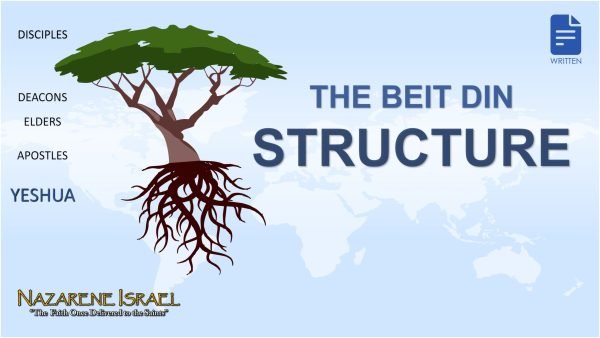
Beit Din Structure
Welcome to Nazarene Israel. My name is Norman Willis. In this study, we want to talk about the duck test with regard to Scripture.
Many people know that the duck test is referring to when you have a bird and you are wondering if it is a duck, so when you take a look you ask yourself the following questions. Does it look like a duck? Does it swim like a duck? Does it quack like a duck? And if the answer to these questions is yes, then it is probably a duck.
But what do you do if you have a bird and it kind of looks like a duck, but not really? And it kind of swims like a duck, but not so much? And it kind of quacks, but not really like a duck? And so, maybe it is not a duck. But what do you do when you have this kind of a thing?
Well, in the case of the apostle Yehuda (Jude), you write him a letter.
Yehudah (Jude) 3
3 Beloved, while I was very diligent to write to you concerning our common salvation, I found it necessary to write to you exhorting you to contend earnestly for the faith which was once for all delivered to the saints.
[Christian-Jewish, Christian-Israelite, Nazarene-Israel]
Jude is saying:
‘You are saved, I am saved, we are all saved here and have a common salvation. I am not saying you are not saved, I am just saying, even though we are both saved, yet still, I found it necessary to write to you, exhorting you to contend earnestly for the faith which was once for all delivered to the saints. Because you are not keeping it. You are not doing and abiding by the original faith. You are practicing some other faith. Your ducks are not in a row!‘
Well, in this study we want to talk about what is called the Beit Din Structure, to illustrate what it means to practice the original first-century faith that was once for all delivered to the saints, and not some other faith like many Messianic do today. Now, do not get your feathers ruffled, but if you do not understand how the Beit Din structure applies to worship in today’s times, you might be laying an egg. Stick around we are going to discuss it all.
There are a lot of renewed covenant (New Testament) believers out there whose ideas do not really fly. One of the reasons why their ideas do not really fly is that they forget that the renewed covenant was not written in a vacuum. The renewed covenant was written primarily by devout first-century Jews, and they wrote it primarily to other devout first-century Jews. There were certain things that were understood in the context of being devout first-century Jews. The renewed covenant is certainly open to those of us of gentile backgrounds, but we need to remember to view the Scriptures of the renewed covenant with what we might call first-century Jewish (Israelite) eyes. Because when we do that it is going to provide a different context, a different flavor, and a different feel, much more than things being lost in the translation. We are going to understand the culture of what is being written about. And that is what we need, elsewise, we are going to miss what the renewed covenant says. So in order to understand the renewed covenant from devout first-century Jewish eyes, we need to begin with the book that all devout first-century Jews would have read, which is of course The Torah of Moshe (The Law of Moses).
Now, in the Law of Moses, in Exodus chapter 18, Moshe’s father-in-law Yitro (Jethro) has come to visit. And he takes a look, and he sees that Moshe is trying to lead the nation but there is really not any order. There is not really any structure or leadership. He says to Moshe that the thing that he is doing is not good! That Moshe is going to wear himself out and the people, that he is not going to make it through to the end. So Jethro instructs Moses on what to do.
Shemote (Exodus) 18:21-22
21 “Moreover you shall select from all the people able men, such as fear Elohim, men of truth, hating covetousness; and place such over them to be rulers of thousands, rulers of fifties, and rulers of tens.
22 And let them judge the people at all times. Then it will be that every great matter they shall bring to you, but every small matter they themselves shall judge. So it will be easier for you, for they will bear the burden with you.”
Jethro instructs Moshe to select from all the people, able men, competent people, such as fear Elohim. They are not going to just read what Scripture says to do, but they are actually going to do it. Men of truth. They want to know the truth and they hate covetousness. Prosperity doctrine is out. And they will bear the burden with Moshe and then everyone can all make it to the goal together. So we see that they had to order and organize themselves, to put things in order so that everything would work right.
We look up the word judge, because that is what we love to do! We love to wake up in the middle of night with a burning desire to read Strong’s Concordance!
Strong’s Hebrew Concordance
H: 8199 (שָׁפַט) shâphaṭ, shaw-fat’
A primitive root; to judge, that is, pronounce sentence (for or against); by implication to vindicate or punish; by extension to govern; passively to litigate (literally or figuratively): –
+ avenge, X that condemn, contend, defend, execute (judgement), (be a) judge (-ment), X needs, plead, reason, rule.
What Jethro is saying is that these leaders over thousands, hundreds, fifties, and tens are there to help govern the people, so the people can achieve their objectives together.
We continue in Exodus chapter 24 to see how this breaks down.
Shemote (Exodus) 24:1-2
1 Now [Yahweh] said to Moshe, “Come up to Yahweh, you and Aharon, Nadab and Abihu, and seventy of the elders of Israel, and worship from afar.
2 And Moshe alone shall come near Yahweh, but they [the seventy elders] shall not come near; nor shall the people go up with him.”
So there is a distinction being made between Moshe, and the seventy elders, and the rest of the people. We are going to see other distinctions.
Bemidbar (Numbers) 1:44
44 These are the ones who were numbered, whom Moshe and Aharon numbered, with the leaders of Israel, twelve men, each one representing his father’s house.
Meaning, we had 12 leaders, one man leading each of the 12 tribes. So we see Moshe, 70 elders, 12 tribal leaders, and the leaders over thousands, hundreds, fifties, and tens, basically all of the people. We are starting to get some order and some organization in the founding document, in the Torah.
Bemidbar (Number) 11:24
24 So Moshe went out and told the people the words of Yahweh, and he gathered the seventy men of the elders of the people and placed them around the tabernacle.
25 Then Yahweh came down in the cloud, and spoke to him, and took of the Spirit that was upon him, and placed the same upon the seventy elders; and it happened, when the Spirit rested upon them, that they prophesied, although they never did so again.
We do not know for certain, but this probably included the 12 tribal leaders because you are not likely to leave them out of this. But what we see here is that basically there were certain qualifications for the 70 leaders. They were capable men, they were lovers of truth and justice, they did not like unrighteous gain (they were not prosperity gospel preachers, this kind of a thing). If we diagram that, basically what we see and will see again later is, it is not the pyramid or the top-down Babylonian-Egyptian elitist pyramid that we see on the back of the United States dollar bill. But rather, it is what we might call an inverted pyramid, or could you even picture a tree structure here?
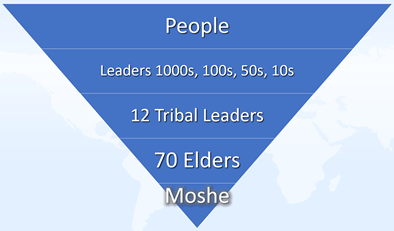
Can you see the trunk, and the branches leading upward, and the leaves spreading forth, being the people?

So we had Moshe serving the 70 elders, they served as did the 12 tribal leaders, and then we will also later see leaders of thousands, hundreds, fifties, and tens leading the people. And this is the concept written in the Torah, that of a well-ordered nation. This is the concept that the first-century Jewish apostles would have understood. They would have understood that the Torah speaks of a well-ordered and organized nation led by the right kinds of people.
Okay, what does that look like? So after Moshe led the children of Israel through the wilderness and then Joshua led them into the Promised Land, how did this work out in real life? Again, let us consider Jethro’s advice in Exodus chapter 18.
Shemote (Exodus) 18:22
22 “… And let them judge the people at all times…”
Now, how does that work out? Well, what we see is what they ultimately settled on were three levels of courts, or what is called the Bet Din Structure. And again, the bigger levels are at the bottom because the trunk of the tree supports the weight upward.
So, in every city, you would have a city court, a court formed with the elders of the city. There are more details to this that we will talk about in other places, but basically, they would form what you might call a Beit Din (a house of judgment or court) for the city. And in each city there was required to be a minimum of three before they could pass judgment, again, we will get into that at some other point in time. This is Levitical structure, and this is when the land is already settled.
Then you would have what is called a Beit Din Katan (a small court) for each of the tribes. Historically, the Beit Din Katan had 23 elders that would perform the judgments.
And then for the nation, you had what is called the Beit Din Gadol (the big court). And historically, that was 71 members, symbolic of Moshe plus the 70 elders of Israel, which again, probably included the 12 tribal leaders. So that is how it was done historically, that was the organization. We were missing the tree structure but that is conceptual anyway.
Well, we come here to Wikipedia and read about the Beit Din. Of course, if it is written in Wikipedia it has got to be true, right? Well, not really, but so let us read what it says.
Beth [Beit] Din: Wikipedia
A beth din (Hebrew: בית דין, romanized: Bet Din, lit. ‘house of judgment’, [bet ‘din],
Ashkenazic: beis din, plural: batei din) is a rabbinical court of Judaism. [1]
In ancient times, it was the building block of the legal system in the Biblical Land of Israel…
…There were three types of courts
(Mishnah, tractate Sanhedrin 1:1-4 and 1:6):
And so Wikipedia says that the Beit Din “was the building block of the legal system in the Biblical Land of Israel”. And actually, that is an understatement.
In the United States for example, and in most western countries, we have what is called a separation of church and state, or between synagogue and state, or between faith and government. And that is purely Babylonian, that the root cause of all the disturbances in the world today, as we are doing this recording in 2021 CE. That is the whole cause.
Now interestingly, in some places, like Russia for example, they have what they call symphony of church and state. They have the wrong church but that is another matter altogether. They have the right concept, just the wrong application. But the idea is that you are supposed to have a coordination, or a symphony, or a harmony. Just like you had Moshe and Aharon who were brothers. They literally worked together; they literally served the nation of Israel together. You are supposed to have cooperation, harmony, and symphony between the government and the faith aspect of things.
So the Beit Din “was the building block of the legal system in the Biblical Land of Israel”. We see it is basically baked right into the cake.
Now, we do not necessarily consider the Mishnah to be accurate, but we do consider it to be an interesting historical reference. So, the Mishnah says that there were three different types of courts.
Beth [Beit] Din: Wikipedia
…The Sanhedrin, the grand central court on the Temple Mount in Jerusalem, numbering 71. [NBW: Beit Din Gadol, Big Court]Smaller courts of 23, called a Sanhedrin Ketana (“small Sanhedrin”). These courts could pass the death verdict. These existed on two levels, the one higher in standing than the other:
The main cities of the tribes, had a court of 23.
So it says, first, you have the Sanhedrin, it is kind of like the papa bear or the grand central court on the temple mount in Jerusalem. Again, numbering 71 members, symbolic of Moshe and the 70 elders. The Greek term that they use is Sanhedrin, we are going to call that a Beit Din Gadol, meaning a Big Court. That is kind of like your Supreme Court for the nation.
Then they have smaller courts, which you might think of as appellate courts or superior courts. Not the supreme court, but superior courts. They would have smaller courts of 23 members for each of the 12 tribes called the Sanhedrin Ketana. We are going to call it a Beit Din Katan. And these courts could even pass a death sentence or a death verdict (serious court!). They existed on two levels; we will talk about that some other time. But the main cities of the tribes (or the headquarters of the tribes, or the capital city of a state, so to speak), were basically 12 states in the nation of Israel that each had a Beit Din Katan court of 23 members.
And then you had all towns of a minimum size. According to the Mishnah, if you had 120 or 230 people you had to have a court of at least 23 members, but the smallest court you could have was a court of three members. Now, we will talk more about this another time, they used voting which is a Babylonian system, we do not go by voting, we go by consensus which is a different concept. But what you see is this basic concept of having the small city courts, then your appellate (superior courts) for the tribe, and then you had the big court (the Beit Din Gadol). And that was your Beit Din Structure. That is how that worked.

But again, take a look diagrammatically. In ancient Israel you had Moshe. Now in the Land of Israel, you had what is called your Nasi which is your prince, president, or your prime minister, so to speak. And then he had his council, effectively, of 70 in the Beit Din Gadol. And then you would have 12 leaders for each tribe, what you would call the Beit Din Katan. So you would have 12 smaller courts (tribal courts). Then for each city, you would have a court of the city elders. And then finally you come to the people who were ordered by thousands, hundreds, fifties, and tens. That is how they did it in ancient Israel.
Well, you might say, ‘Okay, but Norman, that is all Old Testament stuff is it not? I mean, that is all done away with because, after all, we all know the church tells us that Jesus came to nail the law to the cross, and to set us free from the law, and these kinds of things. So surely the Messiah did not use this kind of structure did He?’
Oh, yes! He did!
In Luke chapter 9 we read about the feeding of the five thousand.
Luqa (Luke) 9:14
14 For there were about five thousand men. Then He said to His disciples, “Make them sit down in groups of fifty.”
Once again, we have the division between thousands, hundreds, fifties, and tens. What we are going to see for the rest of this study is that this exact same type of structure existed in renewed covenant times. And by extension, this is the type of system that we as followers of the faith once delivered to the saints need to be organizing ourselves by if we want to pass the duck test.
Again, try not to get your feathers all ruffled! Because here is what we will see in the renewed covenant. You had Ya’akov in the place of the Nasi (prince, president, etc.) of the Beit Din Gadol. A constitutional prince, in other words. And then he had his counsel, we are going to see the Jerusalem council. We do not know if they had 70 members, but we are going to see a council of apostles and elders, also called the foundation of apostles and prophets. Then we are going to see there are 12 apostles (probably included in the 70, we do not know that, but it seems very reasonable that they would be included). Then you have other apostles.
We talk about this in works such as Acts 15 Order and Torah Government, but very interestingly, there are actually 22 named apostles in the Renewed Covenant. This was not a one-time thing where the apostolic structure is done. Again, we talk about that in Torah Government and in Acts 15 Order, so please check those books out. And if you have not read the Nazarene Israel study, please read that one first. Because that will give you the framework. And if you read and understand that work you will know more than about 99 percent of the Christians out there. And if you understand Torah Government and Acts 15 Order, you are going to be way ahead of the rest of the folks. And this is important information because this is how we are supposed to be ordering ourselves, even today.
Now, you have people that call themselves pastor. “Oh, who is your pastor?” Does it occur to anyone there is no such official position as a pastor in the renewed covenant? Yes, there is the gift of a pastor, but the position or the role is that of a city congregational elder, and ideally, there should be at least three or more. It can be done with less, but ideally, you want at least three or more. So, if someone is teaching you that he is a pastor and that is a correct position, ask yourself, does he sound like a duck?
But the main thing we are going to see here is that this is the Melchizedekian order. So it is going to have some slightly different specifics than the Levitical order, but it is going to function on the same precepts. That is the main thing. The same principles and the same precepts apply. Acts 15 is where we are going to see it all come together. In context, this is the so-called Jerusalem council. And remember, originally, it was devout Jews who were going to speak to other devout Jews. The first non-Jew that was brought into the covenant was Cornelius in Acts chapter 10, and then we see that Shaul and Barnabas went to Antioch in chapter 11. And that is where they first began bringing in non-Jew (non-devout, Hellenized, or Hellenistic, what we would today call reformed Jews). And then other true gentiles began to be brought into the faith there in Antioch. So, then we come to chapter 15.
And then plus other true gentiles began to be brought into the faith there in Antioch and what we see then is in Acts chapter 15.
Ma’asei (Acts) 15:1
1 And certain men came down from Judea and taught the brethren, “Unless you are circumcised according to the custom of Moshe, you cannot be saved.”
2 Therefore, when Shaul and Bar Naba [Barnabas] had no small dissension and dispute with them, they determined that Sha

