
The Parable of the Unjust Steward
Executive Summary:
In “The Parable of the Unjust Steward”, Yeshua (Jesus) encourages His disciples (the sons of light) to take shrewd, selfless and altruistic action to help establish a literal discipleship kingdom of Elohim (God) here on this earth. In practical terms, this includes foregoing selfish interest and profit (i.e., mammon) in favor of building the kingdom.
Lesson Plan:
Many Christians and Messianics find the Parable of the Unjust Steward (or Manager) mysterious. If we look at things from Yeshua’s (Jesus’) perspective, it should not be.
To understand the parable from Yeshua’s perspective, first we will read the parable without commentary. Then we will unpack numerous relevant details. Finally, we will repeat the Parable of the Unjust Steward with our commentary in [brackets]. Here is our outline:
1. Read Luke 16:1-15 without commentary.
2. What is the Kingdom of Elohim?
3. First century Jewish historical context.
4. Substitutions: Yahweh, mammon, and us.
5. Shrewdness, Chabad, and Agenda 2030.
6. Read Luke 16:1-15 with [commentary].
7. Conclusion (summation).
Luke 16:1-15 without commentary
Many people are confused by the Parable of the Unjust Steward and Yeshua’s commentary, because it seems like Yeshua is counseling dishonesty. He is not. Rather, He is counseling shrewdness in building His Father’s kingdom, which calls for radical selflessness in the face of hard work (which is why most “disciples” cannot understand it). First let us read the passage without commentary (to get a sense of the difficulties).
Luqa (Luke) 16:1-8 (NKJV with names corrected)
1 He also said to His disciples: “There was a certain rich man who had a steward, and an accusation was brought to him that this man was wasting his goods.
2 So he called him and said to him, ‘What is this I hear about you? Give an account of your stewardship, for you can no longer be steward.’
3 “Then the steward said within himself, ‘What shall I do? For my master is taking the stewardship away from me. I cannot dig; I am ashamed to beg.
4 I have resolved what to do, that when I am put out of the stewardship, they may receive me into their houses.’
5 “So he called every one of his master’s debtors to him, and said to the first, ‘How much do you owe my master?’
6 And he said, ‘A hundred measures of oil.’ So he said to him, ‘Take your bill, and sit down quickly and write fifty.’
7 Then he said to another, ‘And how much do you owe?’ So he said, ‘A hundred measures of wheat.’ And he said to him, ‘Take your bill, and write eighty.’
8 So the master commended the unjust steward because he had dealt shrewdly. For the sons of this world are more shrewd in their generation than the sons of light.
9 “And I say to you, make friends for yourselves by unrighteous mammon, that when you fail, they may receive you into an everlasting home.
10 He who is faithful in what is least is faithful also in much; and he who is unjust in what is least is unjust also in much.
11 Therefore if you have not been faithful in the unrighteous mammon, who will commit to your trust the true riches?
12 And if you have not been faithful in what is another man’s, who will give you what is your own?
13 “No servant can serve two masters; for either he will hate the one and love the other, or else he will be loyal to the one and despise the other. You cannot serve Elohim and mammon.”
14 Now the Pharisees, who were lovers of money, also heard all these things, and they derided Him.
15 And He said to them, “You are those who justify yourselves before men, but Elohim knows your hearts. For what is highly esteemed among men is an abomination in the sight of Elohim.
There are so many themes and levels that it will not be possible to comment on them all in this short article. However, the basic dilemma most people face is this: why does Yeshua commend the unjust steward for being shrewd? And when Elohim values honesty but the steward was unjust and seemingly dishonest, how are we to be righteous without being dishonest ourselves? To answer this dilemma, first we need to define the Kingdom of Elohim, and then we need to understand the cultural context of the parable.
What is the Kingdom of Elohim?
Yeshua tells us that before we do anything else, we should seek first the kingdom of Elohim (God).
Mattityahu (Matthew) 6:33
33 “But seek first the kingdom of Elohim and His righteousness, and all these things shall be added to you.”
As we show in Nazarene Israel, there is more than one level to the kingdom. First there is the basic level, in which the kingdom of Elohim is within us.
Luqa (Luke) 17:20
20 Now when He was asked by the Pharisees when the kingdom of Elohim would come, He answered them and said, “The kingdom of Elohim does not come with observation;
21 nor will they say, ‘See here!’ or ‘See there!’ For indeed, the kingdom of Elohim is within you.”
However, as we also show in Nazarene Israel and in other places, there will come a day when the kingdom is restored to the northern house of Israel (aka Joseph, Ephraim).
Ma’asei (Acts) 1:6
6 Therefore, when they had come together, they asked Him, saying, “Adon, will You at this time restore the kingdom to Israel?”
Finally, there will come a day when both houses of Israel (Judah and Joseph) are reunited in the land, and there will be a millennial nasi (constitutional prince).
Yehezqel (Ezekiel) 37:22
22 and I will make them one nation in the land, on the mountains of Israel; and one king shall be king over them all; they shall no longer be two nations, nor shall they ever be divided into two kingdoms again.
Thus, the kingdom of Elohim is within us, but will become a real physical kingdom again in the future, following the coming apocalyptic end time wars. Yet since the end is known from the beginning, these are merely a coming restoration of what already was in a different form.
The Garden, the Shalom Track, and the War Track
B’reisheet (Genesis) 2:15 tells us that Yahweh put man in the Garden of Eden, to tend it, and to keep it.
B’reisheet (Genesis) 2:15
15 Then Yahweh Elohim took the man and put him in the garden of Eden to tend and keep it.
This shows us that Elohim wants us to tend and keep the Garden (i.e., the earth). Further, we are supposed to reverently serve Elohim and practice true brotherly love (rather than jealousy, strife, and war). However, this is not an easy thing, and it requires practical steps that are spoken of both in the Tanach (Older Covenant) and in the Brit Chadasha (Renewed Covenant).
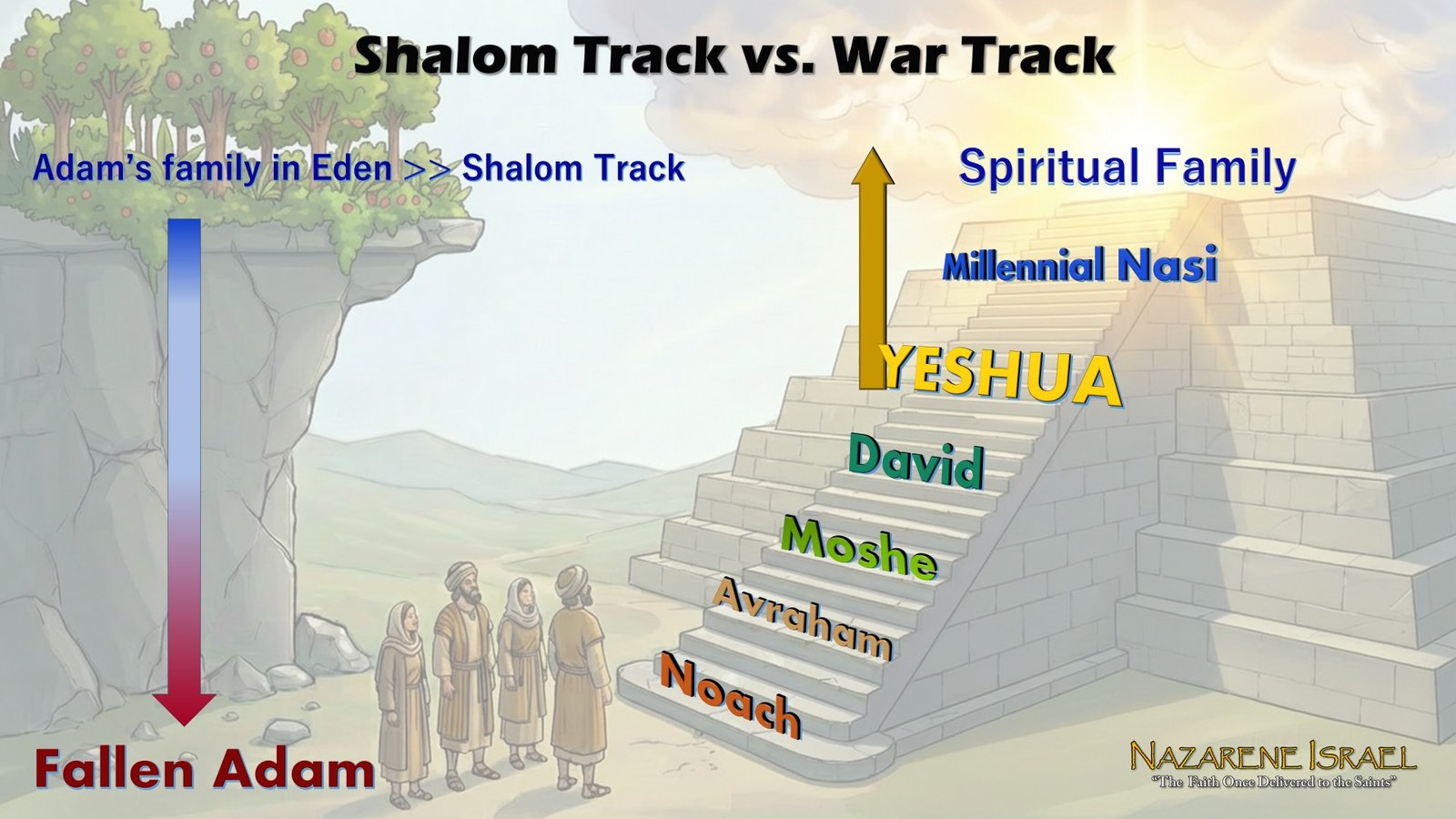
In the Torah Government study and in other places, we explain that if we humans had hypothetically not fallen (i.e., lived up to our spiritual potential), then when Adam eventually died, there would no longer have been a single common ancestor to unify the extended family (as a father-king-ancestor-in-common). At this point, the family would hypothetically have needed to set up a servant-led government to unify the tribes. This would probably have looked very much like the Beit Din Gadol (Sanhedrin) structure that the apostles and elders formed in Acts 15 and Acts 21 (as explained in Torah Government).
Without the establishment of such a servant-led government, the extended family would surely have fragmented along tribal and familial lines of selfish interest, and mankind would inevitably have descended into war (as today). We submit that the full counsel of Scripture suggests that the only solution for this kind of fratricidal war is the eventual establishment of a single global servant-government of man—meaning, unless there is a single global government of man to govern man at Elohim’s instructions (Torah), and unless men submit to it, there will never be an end to war.
The Shalom Track and the War Track
Elohim wants us to live up to our true spiritual potentials. Had we done this in the Garden, we would not have fallen. Rather, we would have lived in a familial kingdom in shalom. This we call conceptually the Kingdom Track, or the Shalom Track, and it is Elohim’s will for all those who believe in Yeshua to the discipleship level.
But of course, we did fall, and so now we have to walk what we conceptually call the War Track. On the War Track lay the three measures of meal that are denatured by the Spirit of Babylon (Judaism, Xtianity and Islam), as we explain in both Nazarene Israel, and in Revelation and the End Times.
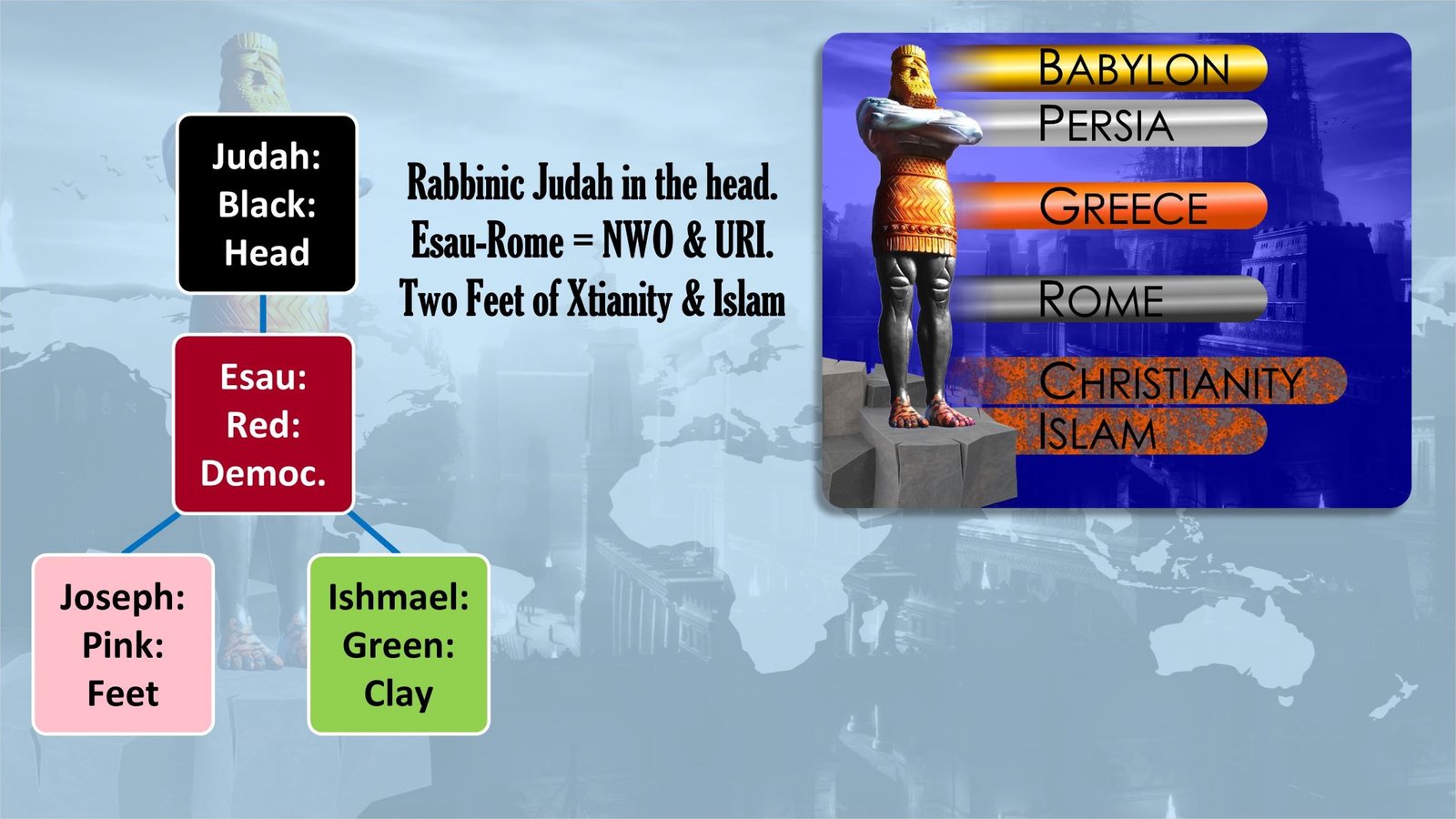
The idea behind the War Track is that Elohim will get what He has always wanted, and mankind can come the easy way (100% willing obedience on the Shalom Track) or the hard way (War Track). And, since men do not like to obey the letter or the Spirit of the Torah, 99+% of men walk the War Track. This is of course 100% completely avoidable, but 99+% of all men will not make the effort to avoid it, because they consider 100% obedience to the Spirit and the Letter of the Torah to be too much effort. (And so, destruction awaits most of them.)
The War Track involves many historic wars, and a series of apocalyptic end-time wars we describe in Revelation and the End Times. At the end of these apocalyptic wars, a remnant of Judah will survive, a remnant of Joseph (Ephraim) will come home, and a remnant of Ishmael will also be brought in. After a time of transition, a millennial government will be established that looks very much like a Nazarene Beit Din Gadol under the direction of a Nazarene nasi (constitutional prince) who at that point will probably be from the tribe of Judah.
Daniel 7:26-27
26 “But the court shall be seated, And they shall take away his dominion,
To consume and destroy it forever.
27 “Then the kingdom and dominion, And the greatness of the kingdoms under the whole heaven, Shall be given to the people, the saints of the Most High. His kingdom is an everlasting kingdom, And all dominions shall serve and obey Him.”
As we explain in Torah Government, the entire point of the Great Commission of Matthew 28:18-20), the Fivefold Ministry (Ephesians 4:11-16), and the Unified Foundation of Apostles and Prophets (Ephesians 2:19-22) is the establishment of a Nazarene Beit Din Gadol to wield this rod of iron —and this is our primary goal. Further, we submit that Yeshua expects us to be shrewd and active in establishing this kingdom (just as Yeshua’s kingship tribe of Judah is shrewd).
The first century Jewish historical context
To understand the Parable of the Unjust Steward, we should understand the first century historical context, which is very different from today’s.
Military subjugation by Greece
Alexander the Great conquered the land of Israel in approximately 332 BCE. His conquest lasted until approximately 167 BCE. This was a time of great military and spiritual oppression known as the Hellenistic Era (or the Greek Era). The books of the Maccabees were written during the latter part of this era. They chronicle how in the latter years, Jewish men and women were put to horrible deaths for trying to keep the Torah.
1 Maccabees 1:60-61 Good News Translation
60 Mothers who had allowed their babies to be circumcised were put to death in accordance with the king’s decree.
61 Their babies were hung around their necks, and their families and those who had circumcised them were put to death.
Many erstwhile Torah-obedient Jews departed from the Torah during this era. These were then called Hellenistic (or Greek) Jews, and these are the Hellenists or the Greeks we read about in the Renewed Covenant. They were genetically Jewish, but rather than keeping the Torah, they embraced a mix of some Hebrew and some Greek (Hellenistic) ways. It was in this context that Yeshua began His ministry and gave the Parable of the Unjust Steward.
The Torah prohibits taking fees or interest, especially from the poor
Several passages in the Torat Moshe (Law of Moses) prohibit Israelites from taking interest from other Israelites—and most especially the poor. The idea is that rather than following the modern-day ethic of making as much money for yourself as you can through usury (i.e., interest and loan fees), you are to treat all other Israelites as you would treat your own literal brothers (or perhaps your children). That is, you should seek to help them out, rather than take advantage of them in their time of need.
The idea is that there will always be some rich and some poor in any society (including Israelite society)—and the rich are not to enrich themselves further by taking pecuniary advantage of their brothers and sisters in Israel. Rather, you should simply help him, provided he is a true disciple of Elohim and keeps all of the other Torah commands. For example:
Shemote (Exodus) 22:25
25 “If you lend money to any of My people who are poor among you, you shall not be like a moneylender to him; you shall not charge him interest.”
Of course this is often ignored, as money has the power to corrupt the souls of the unwary, the greedy, and fools.
Yahweh allows shrewdness with goyim, but not with other Israelites.
In marked contrast to how Israelites are to treat other Torah-obedient Israelites, the Torah tells us that we are allowed (and perhaps, advised) to be shrewd with those of other nations, such that we may charge them interest (and thus enrich the nation of Israel). If we will reflect on this, the goal seems to be to enrich the future-world-governing nation of Israel.
Devarim (Deuteronomy) 23:19-20
19 “You shall not charge interest to your brother—interest on money or food or anything that is lent out at interest.
20 “To a foreigner you may charge interest, but to your brother you shall not charge interest, that Yahweh your Elohim may bless you in all to which you set your hand in the land which you are entering to possess.”
Shrewdness is defined as having or showing sharp, practical judgment and cleverness. To be shrewd is to size up the situation, make smart decisions, and turn the situation to our own advantage (or Israel’s advantage). We may do this with the gentile nations of the world, but we may not do this with a faithful fully-Torah-obedient brother or sister.
However, just as a Hebrew sword has two edges, the flip side to this shrewdness is that we are also to be good to all—especially to those who are of the household of Yeshua (i.e., the Torah-obedient living tabernacle of faith).
Galatim (Galatians) 6:10
10 Therefore, as we have opportunity, let us do good to all, especially to those who are of the household of faith.
The reason Yahweh allows us to act shrewdly with the other nations of the world and charge interest is so that Yeshua’s kingdom grows into world hegemony (i.e., becomes the world’s leading power). Since Yeshua is our Jewish King Mashiach, we are to support our King Mashiach in obtaining His kingdom in His absence however we legally and lawfully can.
The goal is that Yeshua’s nation of Nazarene Israel grows and prospers until it becomes the ruling hegemon of earth. In this way, the poor are lifted up along with us. This also exalts and glorifies Yeshua.
Now let us talk a little more about the Hellenistic concept of charging interest and see how all of this applied in Yeshua’s day, and in the Parable of the Unjust Steward.
Greeks (Hellenists) Usually Charged a Fee instead of Interest.
Many scholars (Derrett, Gibson, Gaechter, Gander, et al) posit that the practice of the steward in the Near East was not to receive a salary from his master, but to loan out his master’s good and to charge a fee or a higher amount in repayment. That is, a steward would loan out his master’s goods, and in return he would require the borrower to pay either the same amount plus a fee, or to pay back more in kind. Then he would take his own pay out of the fee or the extra payback amount.
For example, he might lend fifty measures of his master’s oil and charge payback of 100 measures, or he might lend 80 measures of his master’s wheat and charge payback amount of 100 measures, as he was able. Then he would take part of the increase for his salary. If accurate, this may explain verses 5 through 7.
Luqa (Luke) 16:1-8
5 “So he called every one of his master’s debtors to him, and said to the first, ‘How much do you owe my master?’
6 “And he said, ‘A hundred measures of oil.’ So he said to him, ‘Take your bill, and sit down quickly and write fifty.’
7 “Then he said to another, ‘And how much do you owe?’ So he said, ‘A hundred measures of wheat.’ And he said to him, ‘Take your bill, and write eighty.’”
While this did not violate the letter of the Torat Moshe, it violated the spirit of it. While goods were not lent at interest per se, they were lent with an expectation of increased gain (i.e., usury). This was seen as a way to (unjustly) “get around the letter of the Torah.” In other words, it served as a “legal loophole.” Yeshua would have seen this as unjust.
Compare with Sharia Law
While we are here, in Nazarene Israel and in Revelation and the End Times, we saw that Yahweh loves Ishmael, and that a remnant of Ishmael will also be brought in, after Armageddon. We might then mention in passing that Sharia finance works in much the same way as in the Parable of the Unjust Steward.
In Sharia finance, rather than lending money at interest, lenders make money by trading, leasing, or profit-sharing (i.e., sharecropping) partnerships. The buyer pays back a greater amount than was originally lent—but this is not technically classified as charging interest, but rather as a trading profit or rental fee. However, the reality is that (especially when done with the poor) this is also a loophole with regard to the letter of Torah.
Substitutions: Yahweh, Mammon, Us, the Levitical Order, Chabad, and Agenda 2030
The Parable of the Unjust Steward is multi-layered and with many facets. There are literally dozens of doctoral dissertations and hundreds of master’s theses on this parable, but our goal is to get to the main points as quickly as possible. So now with all of this background knowledge, let us suggest some substitutions in the parable, to unlock Yeshua’s true meanings.
We suggest substituting in Yahweh for the Master, substituting money for mammon, and us-as-disciples for the unjust steward. Due to space limitations, we will only explain the substitution of money for mammon (as the others should hopefully be self-explanatory).
Substituting money for mammon
As mentioned above, what Yahweh always wanted in the garden was a single family of man working together, pooling their resources to worship Him and take care of His planet. In other words, what Yahweh wanted was an ideal brotherhood of man. Further, according to the Law of First Mention, since this was our original job, it is still our job, as this is what Yahweh has always wanted from us (and He still wants it).
In small families you can see true communal social sharing even today. Families band together and work for the good of the whole under the leadership of the clan patriarch (for the good of the clan). However, this kind of altruism is typically limited to very small clans, and to primitive and agrarian societies. This kind of altruistic social structure has always broken down in larger (more anonymous) societal contexts requiring advanced skill sets.
This may be due to human laziness and greed, but also to lack of effective oversight. (This is especially in advanced secular social contexts such as secular socialism, secular communism, and democracy). At least as this point in man’s development, most humans only work for money and personal gain (rather than working for the common good of all mankind)—yet Yahweh still wants the same single self-governing family of man that He wanted in the Garden (and we are promised that in the end, Yahweh will get what He wants).
If what Yahweh really wants is a single family of man that works together in an altruistic and communal manner to worship Him and care for His planet while taking care of His poor, then in comparison, profit-driven banking and the charging of interest would seem grotesque and perverted. Wealth inequality would seem gross. Profit and usury toward the poor would seem unjust. All forms of profit would seem like mammon. (We will comment on this further near the second half of the Parable of the Unjust Steward, where Yeshua likens mammon to money.)
The Socialist Levitical Order
As we explain in Torah Government, the twelve tribes operate on a free-market capitalist model. However, in contrast, the Levitical Order is organized according to what might be termed a four-tier “believing socialist” structure. There are the Levites (which receive an average salary), the priests or cohenim (which receive a tithe of the tithe), and the high priest or cohen hagadol (who receives a tithe of the tithe of the tithe).
Regardless of differences in pay, and regardless of the flat tiered pay structure, each member of the order is expected to do his best for the mission success of the priesthood and the nation as a whole. This compares with government multi-tiered pay structures today.
Now let us consider that the Levites were chosen to be an example of how to live according to Torah to the rest of the tribes. They were set apart as a dedicated tribe to serve as religious, moral, and judicial role models for the rest of Israel. They were not just to teach, but also to demonstrate the laws of the Torah. They operated on what could be called a “believing socialist” basis. Money was not to be their prime motivator. Rather, zealous and passionate service to Elohim and His people was to be their motive and prime driver.
If we take this all together, we submit that Yahweh’s ultimate end game is to restore that which has been lost, not just with the northern house of Israel (Joseph), but also with regards to the altruistic brotherhood of man that was lost after the Garden of Eden.
Mattityahu (Matthew) 18:11
11 “For the Son of Man has come to save that which was lost.”
The Chabad and Agenda 2030
In our coming expansion of the Revelation study, we hope to show how Yahweh plans to restore the original extended-family social structure in which all of Israel is taken care of, provided that they obey all points of the Torat Moshe (both the Spirit and the letter). As a transitional step, those nations who do not join Israel will be held in control by the electronic control gird that the Chabad and their subsidiaries (i.e., the Illuminati and the Masonic Lodge) are developing now. However, for now it is enough to know that the Chabad is a central agent of the coming apocalyptic changes.
As explained in Robert Sepher’s highly recommended book, 1666: Redemption Through Sin, the Chabad is literally a synagogue of Satan that was born of Jacob Frank and Rothschild financing. Frank worshiped Satan (as the Chabad still does today, under the guise of serving Yahweh). While this is nothing to emulate it is also not a cause for fear, because Satan must come to Yahweh to get permission for whatever he does—and as a wise master strategist, Yahweh only allows that which furthers His end-time goals.
Iyov (Job) 1:12
12 And Yahweh said to Satan, “Behold, all that he has is in your power; only do not lay a hand on his person.” So Satan went out from the presence of Yahweh.
In 1666: Redemption Through Sin, Robert Sepher also documents that the Jewish money power is in charge of global finance, and that they also financed Bolshevism and the Communist revolution (and hence, they control it). Beyond this, they also effectively own and control the Illuminati and the Masonic Lodge, who control all or most-all governments and corporations, due to their control over the monetary systems of the world.
The Illuminati and the Masonic Lodge are presently advancing Agenda 2030, in which the idea is for people to “own nothing and be happy”, and to work for the good of the collective New World Order. All of this is in keeping with the Talmud, as reflected in the letter from Baruch Levy to Karl Marx, as printed in La Revue de Paris, pp 574, June 1, 1928.
In our expansion of the Revelation study we also hope to show that all of this would further be in keeping with the goal of growing Israel into the world hegemonic power, except that Zera-ite Judah plans to bring this about without Yeshua as the core (which, of course, Yahweh will not allow, according to Psalms 2).
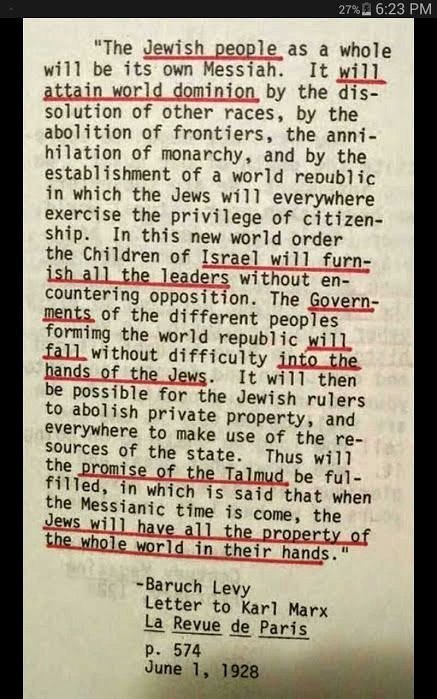
Because someone will ask, the Chabad’s rod of iron (control grid) will be handed to Nazarene Israel when the remnant of Judah converts to the Nazarene Israelite faith at Yeshua’s triumphal return.
Zecharyah (Zechariah) 12:10
10 “And I will pour on the house of David and on the inhabitants of Jerusalem the Spirit of favor and supplication; then they will look on Me whom they pierced. Yes, they will mourn for Him as one mourns for his only son, and grieve for Him as one grieves for a firstborn.
Prior to this time, it will not be possible to establish the kind of altruistic society that Yahweh Elohim desires, although we should make all possible preparations.
Read Luke 16:1-15 [with commentary].
While there are more levels to the parable than we have room to explore here, with this information we can plug in the substitutions to the Parable of the Unjust Steward and see how Yeshua encourages us to be selfless and shrewd for the coming kingdom, regardless of personal cost, so as to establish Nazarene Israel as the future global hegemonic power. I will comment on those levels we are exploring in this short study in [brackets].
Luqa (Luke) 16:1-15 [with comments]
1 [Yeshua] also said to His disciples: “There was a certain rich man [Yahweh] who had a steward [us as His disciples], and an accusation was brought to him that this man [i.e., us] was wasting his goods [because he was seeking personal profit, rather than the good of all Israel/all mankind].
2 So he called him and said to him, ‘What is this I hear about you? Give an account of your stewardship, for you can no longer be steward.’ [i.e., you will die and go to the Judgment.]
3 “Then the steward said within himself, ‘What shall I do? For my master is taking the stewardship away from me. I cannot dig; I am ashamed to beg.
4 I have resolved what to do, that when I am put out of the stewardship, they may receive me into their houses.’
5 “So he called every one of his master’s debtors to him, and said to the first, ‘How much do you owe my master [after the added fee]?’
6 And he said, ‘A hundred measures of oil.’ So he said to him, ‘Take your bill, and sit down quickly and write fifty [because that is what you originally borrowed].’
7 Then he said to another, ‘And how much do you owe?’ So he said, ‘A hundred measures of wheat.’ And he said to him, ‘Take your bill, and write eighty [because that is what you originally borrowed].’
Here we see the unjust steward discounting the extra commission or fee. He is not seeking any kind of usury for personal worldly gain, although he is making sure his master gets paid back.
8a “So the master [Yahweh] commended the unjust steward [the good disciple] because he had dealt shrewdly.”
The steward was shrewd in that he turned an unfavorable situation into a favorable one both for himself and his master, since both the steward and the master now received favor from the community for forgiving usury, while the master still recouped his original investment. This is especially important when we realize that in Shemite society, one’s name in the community is of extreme importance (much more so than in traditional Yaphethite society).
8b “For the sons of this world are more shrewd in their generation than the sons of light.
9 “And I say to you, make friends for yourselves by [giving of your] unrighteous mammon [to the poor, because all profit is effectively unrighteous compared to the true global family Yahweh wants], that when you fail, they may receive you into an everlasting home.”
This can be interpreted at multiple levels. One is that of gaining favor with other Israelites here on earth, but most importantly with Yahweh the Father in heaven.
10 “He who is faithful in what is least [money, profit] is faithful also in much [spiritual matters]; and he who is unjust in what is least [money, profit] is unjust also in much [spiritual matters].
11 Therefore if you have not been faithful in the unrighteous mammon, who will commit to your trust the true riches [eternal life]?
12 And if you have not been faithful in what is another man’s [Yahweh’s third tithe for the poor, because all money ultimately belongs to Yahweh], who will give you what is your own?
13 “No servant can serve two masters; for either he will hate the one and love the other, or else he will be loyal to the one and despise the other. You cannot serve Elohim and mammon.”
14 Now the Pharisees, who were lovers of money, also heard all these things, and they derided Him.
15 And He said to them, “You are those who justify yourselves before men, but Elohim knows your hearts. For what is highly esteemed among men is an abomination in the sight of Elohim.”
We know that this parable is about money as mammon, because in verse 14 we are told that the Pharisees seek worldly riches (rather than the true spiritual ones).
Conclusion and Summary
In the Parable of the Unjust Steward, Yeshua advocates for shrewd action to restore the original brotherhood of man that Yahweh Elohim has always wanted. He also advocates shrewd and selfless action in pursuit of this goal. Money and personal profit are not to be our goals—but rather, the opportunity to worship and serve Yahweh Elohim.
After the coming end-time apocalyptic wars, the remnants of Judah and Joseph will be brought together as one, and a remnant of Ishmael will also be joined to them. This will be a new era, and with the advent of the electronic control grid it will be possible for Nazarenes to rule and reign over the nations of earth who do not want to eagerly obey the letter and Spirit of the Torah.
And, if we are willing to accept it, the Spirit and letter of the Torah calls for a brotherhood of man that looks like the extended family that should always have existed, had we hypothetically never fallen from favor in heaven. This coming spiritual renewal in Yeshua HaMashiach will give us the opportunity to overcome the kinds of selfish interest that causes wars and death worldwide.
Yaakov (James) 4:1-5
1 Where do wars and fights come from among you? Do they not come from your desires for pleasure that war in your members?
2 You lust and do not have. You murder and covet and cannot obtain. You fight and war. Yet you do not have because you do not ask.
3 You ask and do not receive, because you ask amiss, that you may spend it on your pleasures.
4 Adulterers and adulteresses! Do you not know that friendship with the world is enmity with Elohim? Whoever therefore wants to be a friend of the world makes himself an enemy of Elohim.
5 Or do you think that the Scripture says in vain, “The Spirit who dwells in us yearns jealously”?
There is much more to say, and many other levels to explore, but the Parable of the Unjust Steward shows us the selfless and altruistic Spirit that will allow us and our children to establish the kingdom of Elohim that Yeshua has always wanted, so that we serve Him as a single self-governed family of man, as He always wanted.
Shalom
Support the Great Commission on PayPal
Support the Great Commission on Patreon