
Why Yeshua is Mashiach Nagid (Messiah the Prince) of Daniel 9:25-26
Executive Summary:
This article will show a mathematical and chronological proof that only Yeshua ben Yosef (Jesus) can ever fulfill the prophecy over Mashiach Nagid (Messiah the Prince) in Daniel 9:25-26. This is because Daniel 9:25-26 says that Mashiach Nagid would arrive in 26 CE, near the end of the Second Temple Era (which is when Yeshua came).
Further, since this is a past date, Orthodox Judah is making a (perhaps well-intentioned) mistake by looking for Mashiach Nagid to arrive in the future.
1. The Historical Context in Daniel and Jeremiah
To get the greater context of Daniel 9:25-26, let us start in Daniel 9:1. It is the first year that King Darius has begun to reign in the Persian Empire.
Daniel 9:1
1 In the first year of Darius the son of Ahasuerus, of the lineage of the Medes, who was made king over the realm of the Chaldeans—
Daniel has read the prophecies of Jeremiah (for example, Jeremiah 25:11-12), and he understands that Yahweh (Jehovah) would cause Judah (or the Jews) to go into the Exile to Babylon for 70 years, for their failure to obey the Torah of Moshe (or the Law of Moses).
Yirmeyahu (Jeremiah) 25:11
11 “And this whole land shall be a desolation and an astonishment, and these nations shall serve the king of Babylon seventy years.”
However, in Jeremiah 29:10, Yahweh also prophesied through Jeremiah that at the end of those 70 years, Yahweh would bring the house of Judah back to the land of Israel.
Yirmeyahu (Jeremiah) 29:10
10 “For thus says Yahweh: After seventy years are completed at Babylon, I will visit you and perform My good word toward you, and cause you to return to this place.”
So now continuing in Daniel, in Daniel 9:3, realizing that the time was up, Daniel set his face toward Yahweh Elohim to make request by prayer and supplications, with fasting, sackcloth, and ashes, that Yahweh might bring Judah home.
Daniel 9:3
3 Then I set my face toward Yahweh Elohim to make request by prayer and supplications, with fasting, sackcloth, and ashes.
The Prophecy in Daniel 9:25-26.
So now if we drop down 20 verses to Daniel 9:23, we see that Yahweh sent the Messenger (or in this case, the Archangel) Gabriel in answer to Daniel’s prayer, and Gabriel delivers an amazing message about not just the return of Judah, but also about the restoration of the city (Jerusalem).
Daniel 9:23
23 “At the beginning of your supplications the command [from Elohim] went out, and I have come to tell you, for you are greatly beloved; therefore, consider the matter, and understand the vision.”
The 70 Weeks of Years
What are we told to consider and understand? Verse 24 tells us that seventy weeks (of years) are determined for the Judah, and for the set-apart city (Jerusalem).
Daniel 9:24
24 “Seventy weeks are determined For your people and for your set-apart city, To finish the transgression, To make an end of sins, To make reconciliation for iniquity, To bring in everlasting righteousness, To seal up vision and prophecy, And to anoint the Most Set-apart.”
The Hebrew for “weeks” is shavuim (שָׁבֻעִים), which is plural. The root is Strong’s Hebrew Concordance #7620, shavua, meaning literally “seven.”
H7620
שְׁבֻעָה שָׁבֻעַ שָׁבוּעַ
shâbûa‛ shâbûa‛ shebû‛âh
shaw-boo’-ah, shaw-boo’-ah, sheb-oo-aw’
Properly passive participle of H7650 as a denominative of H7651; literally sevened, that is, a week (specifically of years): – seven, week.
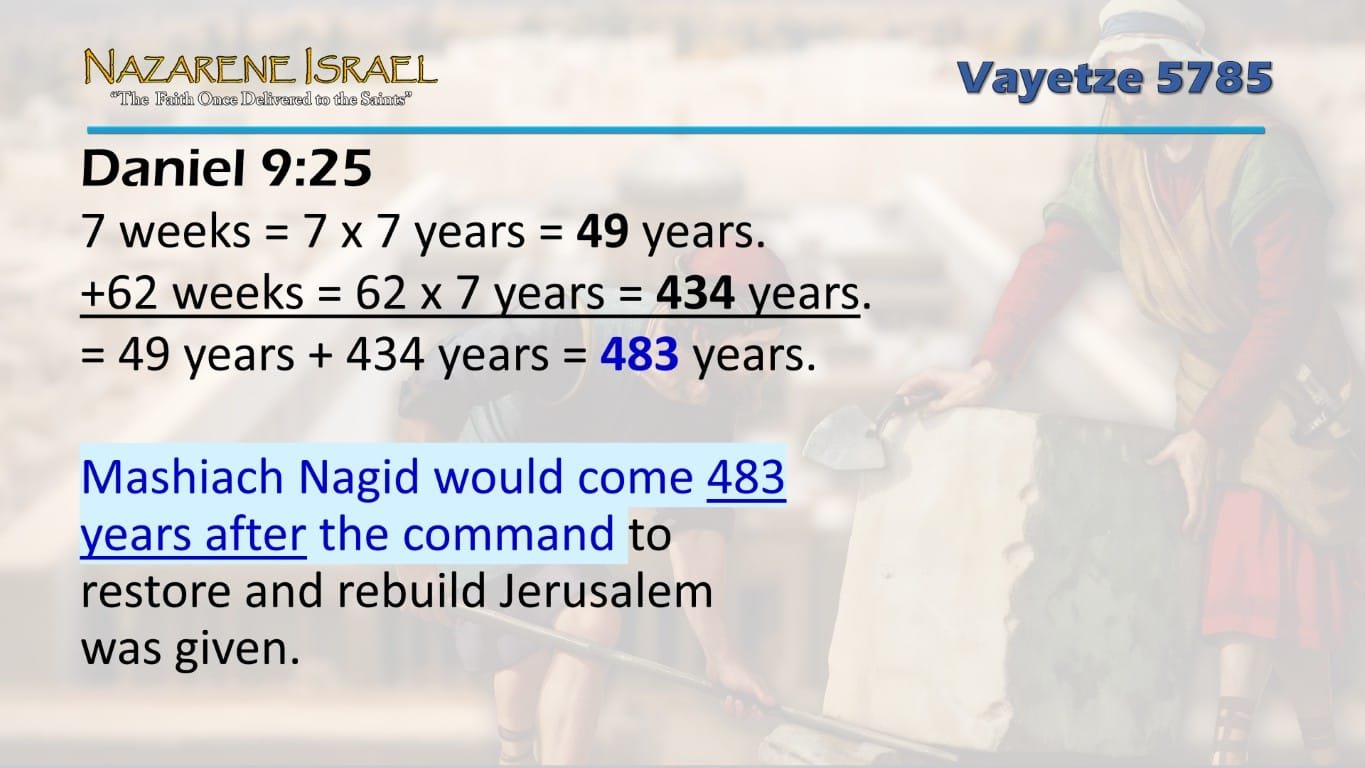
In context, then, Daniel 9:24 speaks of 70 sevens, or 70 “weeks of years”, meaning 490 years. Daniel 9:25 then tells us that Mashiach Nagid would come 7 weeks of years (i.e., 49 years) and 62 weeks of years (i.e., 434 years) after the command went forth to restore and rebuild Jerusalem. This is what we need to know and understand.
Daniel 9:25
25 “Know therefore, and understand, That from the going forth of the command To restore and rebuild Jerusalem Until Mashiach Nagid, There shall be seven weeks plus sixty-two weeks; The street shall be built again, and the wall, Even in troublesome times.”
Don’t Forget the Wall!
Another essential thing we must know and understand is that whoever gave the command to restore and rebuild Jerusalem, his command must have led not only to the streets of Jerusalem being rebuilt, but the wall also must have been rebuilt (and this is what Orthodox Judah and the Noachides forget). We will come back to this fact later.
Mashiach is Cut Off Before the Temple is Destroyed
In a moment we will see who gave the count that led to the streets and the wall being rebuilt. However, if we also read Daniel 9:26, we can see that Mashiach had to come during the Second Temple Era, because Mashiach was to be cut off (but not for Himself) before the “prince who was to come” would destroy the city and the sanctuary.
Daniel 9:26
26 “And after the sixty-two weeks [of years] Mashiach shall be cut off, but not for Himself; And then the people of the prince who is to come Shall then destroy the city and the sanctuary…”
Since the Roman General Titus destroyed Jerusalem in 3830 (70 CE), Mashiach Nagid must have arrived before 3830 (70 CE).
Three Choices of Starting Point for the 483-year Count.
Three different kings gave a command to restore and rebuild Jerusalem. So, now we need to discover when the commandment was given to restore and rebuild Jerusalem, such that the streets and the wall were also rebuilt. This requires only some basic investigation and simple arithmetic.
Do the Math
We have already seen how Daniel 9:25 says Mashiach Nagid would arrive 7 weeks of years plus 62 weeks of years after the command was given to restore and rebuild Jerusalem, provided that the streets and the wall were also rebuilt. In other words, we are looking for a command that went forth where the streets and the wall were also rebuilt, and Mashiach Nagid came 483 years later—and this must be before the city and the Temple were destroyed in 3830 (70 CE).
Option #1: Why King Koresh (King Cyrus) is Incorrect.
The first command to restore and rebuild Jerusalem was given by King Koresh (Cyrus). Ezra 1:1 talks about the decree that King Koresh of Persia gave, letting the house of Judah go home. This decree technically ended the Babylonian Captivity and began the Second Temple Era.
Ezra 1:1-3
1 Now in the first year of Koresh king of Persia, that the word of Yahweh by the mouth of Jeremiah might be fulfilled, Yahweh stirred up the spirit of Koresh king of Persia, so that he made a proclamation throughout all his kingdom, and also put it in writing, saying,
2 Thus says Koresh king of Persia: All the kingdoms of the earth Yahweh Elohim of heaven has given me. And He has commanded me to build Him a house at Jerusalem which is in Judah.
3 Who is among you of all His people? May his Elohim be with him, and let him go up to Jerusalem which is in Judah, and build the house of Yahweh Elohim of Israel (He is Elohim), which is in Jerusalem.
We might think that the 483-year count begins here, and Orthodox Judah does teach (incorrectly) that the count begins here—but there are two big problems that disqualify his decree.
Problem #1: the Wall Was Not Rebuilt
The first problem with using King Koresh’s command is that the wall was not rebuilt after His command went forth, and as we already saw, this was part of the requirements given in Daniel 9:25.
Problem #2: No Mashiach Nagid Figure Arrived.
The second problem is that there was no Mashiach Nagid figure who arrived 483 years after King Koresh gave his command. So, as much as we might want to make this the starting point, it does not qualify, because it does not match the prophecy—and other (better) options exist.
For those who want to do the math, scholars believe that King Koresh conquered Babylon around 3221 (or 539 BCE). Then he gave his proclamation to restore and rebuild Jerusalem approximately a year later, around 3222 (or 538 BCE).
If we hypothetically start with 3222 and then add the prophesied 483 years of delay, we get a hypothetical arrival date for Mashiach Nagid of around 3705 (or 55 BCE)—but no one came in a Mashiach role then! That is to say, there is no Mashiach Nagid figure who arrived in 3705—so King Koresh’s command does not work.
Option #2: Why King Darius is Incorrect
If King Koresh’s decree in Ezra is not the start of the 483-year count, then what is? We have two more options.
For option number #2, if we start in Ezra 5:3, we learn that although King Koresh had commanded that Judah should restore and rebuild the temple, the local governor Tattenai had hindered the work, so the temple did not get finished.
Ezra 5:3
At the same time Tattenai the governor of the region beyond the River and Shethar-Boznai and their companions came to them and spoke thus to them: “Who has commanded you to build this temple and finish this wall?”
When this violation of King Koresh’s original decree was brought to the attention of the succeeding King (Darius), King Darius gave his own decree, telling Tattenai and others not to hinder Judah, but to allow and even assist them in carrying out King Koresh’s original decree.
Ezra 6:8
8 Moreover I issue a decree as to what you shall do for the elders of these Jews, for the building of this house of Elohim: Let the cost be paid at the king’s expense from taxes on the region beyond the River; this is to be given immediately to these men, so that they are not hindered.
King Darius’ decree went forth around 3240 (or 520 BCE). However, the problems with using King Darius’ decree as the start point are the same as those of King Koresh’s decree.
Problem #1: the Wall Was Not Rebuilt Then Either
The details are found in Ezra chapters 5 and 6, but the short version is that while the people were allowed to finish rebuilding the temple, the walls were not rebuilt at that time.
Problem #2: No Mashiach Nagid figure Arrived
Moreover, if we start the 483-year count at the time of King Darius’ decree in 3240, we arrive at 3723 (or about 37 BCE)— and again there was no Mashiach Nagid figure who arrived in 3723. So, King Darius’ decree does not meet the requirements either.
Option #3: Why King Artashasta (Artaxerxes) is Correct
The third and final option is the decree that was given by King Artashasta (Artaxerxes the 1st).
Reason #1: the Wall WAS Finally Rebuilt
King Artashasta’s decree to restore and rebuild Jerusalem went forth around 3303 (or 457 BCE). Although the Temple was already built, King Artashasta’s decree allowed the rebuilding of Jerusalem’s walls, as recorded in Nehemiah 2:8.
Nehemiah 2:8
8 and a letter to Asaph the keeper of the king’s forest, that he must give me timber to make beams for the gates of the citadel which pertains to the temple, for the city wall, and for the house that I will occupy.” And the king granted them to me according to the good hand of my Elohim upon me.
This finally fulfilled all of the requirements of Daniel 9:25.
Reason #2: Mashiach Nagid DID Come Then!
Moreover, if you add the prophesied 483 years of delay to the start point of 3303, you get an arrival date for Mashiach Nagid of around 3786 (or 26 CE), which is the same year it is believed that Yeshua ben Yosef (or “Jesus the Son of Joseph”) began His ministry.
Reason #3: Mashiach Was Cut Off, But Not for Himself
Yeshua ben Yosef also fulfilled the prophecy over Mashiach Nagid of Daniel 9:26, in that He was cut off, but not for Himself, before the destruction of the Second Temple.
Daniel 9:26
26 “And after the sixty-two weeks [of years] Mashiach shall be cut off, but not for Himself; And then the people of the prince who is to come Shall then destroy the city and the sanctuary…”
What this says is that Mashiach Nagid had to come near the end of the Second Temple Era, before the city and the sanctuary were destroyed in 3830. By extension, this means that Mashiach Nagid cannot come today, because it is a past event—and there is only one Man in all of history who meets all of the necessary qualifications, and who came at just the right time—and that Man is Yeshua ben Yosef.
And in the next chapter, we will see other reasons why we cannot give up our faith on Mashiach Yeshua.
Shalom!
Support the Great Commission on PayPal
Support the Great Commission on Patreon
We thank Yahweh Elohim for your love for His kingdom.