What is Trinity? Sanhedrin and Nazarene Israel dialogue
Fair Use: Pro-Israel Content, Academic Content, Autistic Content:
The following text is an outline summation of the video dialogue only. For complete dialogue, please view video.
Threats from Ulf Diebel, Sanhedrin representative April 2025
As some of our viewers may recall, in April 2025 (5785), Norman Willis of Nazarene Israel and the House of Joseph (HaMin HaNetzerim) received an attack from Ulf Diebel, a ‘Noahide’ Sanhedrin representative, via our Nazarene Israel YouTube channel. In Mr. Diebel’s comment, he threatens that as long as Norman Willis (and Nazarene Israel) hold to our religious beliefs concerning our Mashiach, Yeshua, he (and Nazarene Israel) will be “one of the first cases dealt with once the Sanhedrin is fully functionable“.
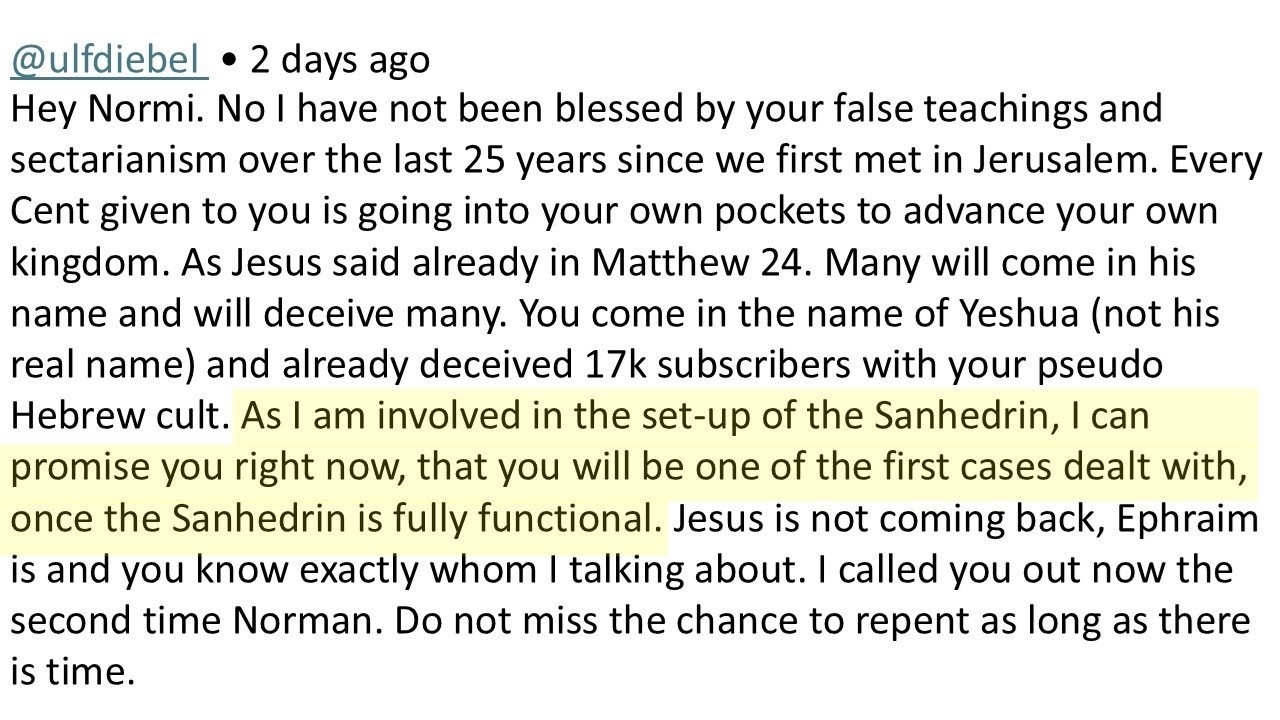
As explained in the intro to this video, Norman has experienced a long history of death threats from Orthodox Jewish community. Also, it is known that devote Orthodox Jews pray the death curse against all Christians (the Birkhat HaMinim) 3 times each day (except for on Shabbat). The attack from Ulf Diebel was essentially a continuation of these death threats, directed against Norman Willis and Nazarene Israel for our Tanakh-based faith in Yeshua as our ‘divine’ Mashiach’.
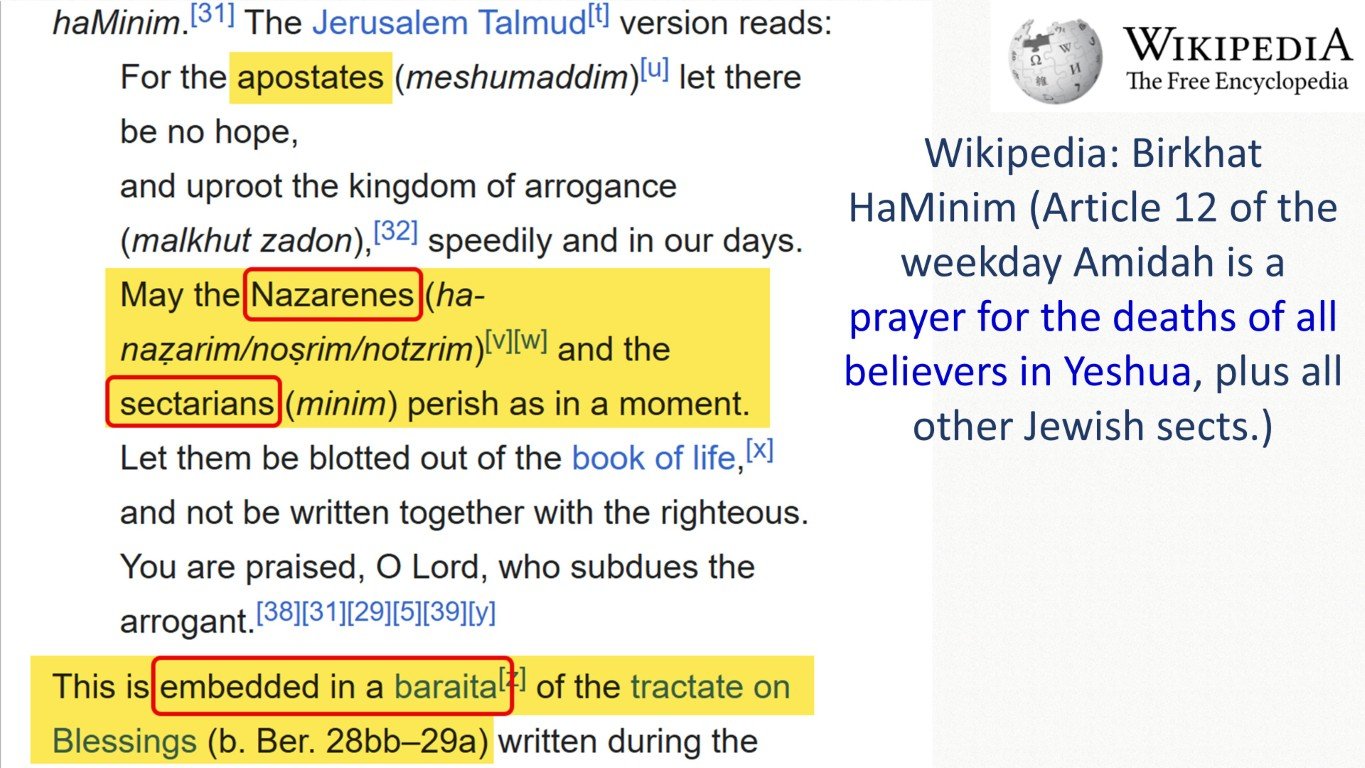
For more on the Birkhat HaMinim, the Orthodox Jewish death curse against all Notzrim (or Christians), we recommend these studies, below.
Persecution: The Birkhat HaMinim (written)
Joseph Translate: The Rabbis Want YOU Dead! (Berakhot 28b-29a) (short)
End the War Against Joseph (video series)
More ‘death threat’ rhetoric from Ulf Diebel, Sanhedrin representative, 2026
As of May-June 2026, Norman received a another ‘mention of death’ from Sanhedrin from Ulf Diebel which included similar death threat rhetoric, stating that “as long as you declare Jesus to be divine, or God, you are also a false prophet worthy of death“.
“I am not in rebellion Norman, I am at war against the dragon, the beast and the false prophet, I will definitely win. And as long as you declare Jesus to be divine, or God, you are also a false prophet worthy of death. Here is my point.”
[Ulf Diebel, email to Norman Willis, received on 5 June 2026]
After this intimation of threat, we received a surprise invitation to meet with Rav Yosef Edery, the lead advisor to the Sanhedrin Initiative, to meet and discuss the doctrine of the Trinity, and Nazarene Israel’s stance on the topic.
It is too bad that invitations to join in on respectful dialogue with the house of Judah always seem to be related to some type of threat. (Hopefully, Judah will one day stop threatening Joseph!) That said, we were very happy to receive the invitation and pleased with the dialogue that followed with Rav Edery. We pray for much more respectful dialogue on these type of crucial doctrinal topics. May Yahweh Elohim please want it.
Yeshayahu (Isaiah) 11:13
13 Also the envy of Ephraim shall depart, And the adversaries of Judah shall be cut off; Ephraim shall not envy Judah, And Judah shall not harass Ephraim.
11 June 2026 (5786) dialogue summation:
The following is video dialogue between Rav Yosef Edery (Sanhedrin Initiative Lead Advisor), Ulf Diebel (Noahide representative to Sanhedrin Initiative), and Norman Willis (of Nazarene Israel and the House of Joseph (HaMin HaNetzerim) on the topic of ‘the Trinity’, which took place on 11 June 2026 (5786).
It should be noted that while Nazarene Israel 100% defends Tanakh-based doctrine of a ‘divine’ Mashiach, Nazarene Israel 100% opposes and rejects the Roman doctrine of a Trinity. Because many do not understand the difference, we were happy to accept the invitation to dialogue with Judah, and to present the difference between Nazarene Israel’s “Tanakh-based doctrine of ‘manifestations’ of Elohim” verses Roman doctrine of a ‘Trinity”.
For more studies on Trinity doctrine, we recommend:
Immersion in Yeshua’s Name Only
Yeshua the Manifestation of Yahweh
There are many topics that the Two Houses could discuss doctrinally. We hope to continue dialogue in the future on topics such as divinity of the Mashiach, prophetic events, ending the Orthodox Jewish Birkhat HaMinim death threat against all Notzrim, and other Tanakh-based theology, if Yahweh Elohim should want it. We pray always for blessings over the house of Judah. We hope and pray that Judah will end death threats against the House of Joseph, that Judah and Joseph may have more respectful dialogue together and find commonalities between the both houses, for the praise of Yahweh Elohim and His Kingdom.
Please pray for continued respectful dialogue
The following is a summation of the dialogue which took place between Rav Edery, Ulf Diebel, and Norman Willis on 11 June 2026 (5786) through an online call.
Nazarene Israel continues to pray for respectful (non-threatening) dialogue with the House of Judah, to further Two-House unification efforts upon the Tankah, the one book both houses have in common, without death threats against our people. It is our desire to see Judah and Joseph unify as brothers, rather than attacking one another. (Thank you for praying with us.) And as Golda Meir famously said, “You cannot negotiate peace with somebody who has come to kill you.”
“You cannot negotiate peace with somebody who has come to kill you.”
[Golda Meir]
What Is the Trinity?! | Halacha, Shituf & the Truth of Shema Yisroel [Yisrael]
In “What is the Trinity?” Rabbi Yosef Edery (Sanhedrin Initiative) hosts a theological and historical discussion with Ulf Diebel (Sanhedrin Noahide representative) and Norman Willis (Nazarene Israel and House of Joseph/HaMin HaNetzerim), covering topics of Jewish and Nazarene halachot, pagan roots, and absolute monotheism.
Together, they explore the origins of the Trinity, its standing in Jewish Halacha (law), and how it compares to the absolute monotheism of Judaism from historic, Jewish, and biblical perspectives. The conversation compares the biblical doctrine of ‘manifestations of Elohim’ with mainstream Catholic Trinity doctrine, and presents whether Trinity doctrine is a byproduct of Roman political maneuvering and pagan syncretism.
The Jewish Perspective on the Trinity: Monotheism and Shituf
Rabbi Yosef opens the dialogue by outlining the traditional Jewish stance on the Trinity. Judaism is anchored in uncompromising monotheism, famously articulated in the Shema Yisrael: “Shema Israel, HaShem is our G-D, HaShem is one” (“Hear O Israel, Yahweh our Elohim, Yahweh is one”). This unity is absolute and indivisible.
In Jewish legal terms, belief in a multi-part deity falls under Shituf (association or partnership). While there is ongoing rabbinic debate on whether Shituf is strictly prohibited for non-Jews (Noahides), for a Jew, assigning divinity to multiple entities is a direct violation of monotheism and constitutes Avodah Zarah (idolatry).
Rabbi Yosef uses a brilliant analogy to explain how ‘HaShem’ interacts with the world. He compares ‘HaShem’s’ various names (like Elohim or the four-letter name Yud-Hei-Vav-Hei) to different electrical voltages in a house—each customized for a specific purpose, but all originating from the exact same power source. ‘HaShem’ may reveal Himself through natural phenomena or the supernatural, but these are merely “filters” used to interact with a limited human reality, not separate deities.
Reassessing the Trinity: A Return to the Texts
Norman Willis challenges mainstream Protestant and Catholic teachings. Willis argues that the traditional Christian concept of a “three-in-one” God (Elohim) is simply not found in the Tanakh (Hebrew Bible) or the original New Testament manuscripts. He points out that the famous “Johannine Comma” (1 John 5:7-8), a passage frequently used to prove the Trinity, was actually added to Latin manuscripts centuries later as an interlinear gloss.
Willis acknowledges that biblical texts and Jewish mystical works like the Zohar do describe various manifestations of Elohim—such as a greater presence (Greater Yahweh), a lesser messenger (Lesser Yahweh), or the Spirit. However, he emphasizes that limiting Elohim to strictly three persons puts the Creator in an artificial box. Willis suggests that by boxing Elohim into a rigid “Trinity,” mainstream Christianity inadvertently adopted pagan concepts, mirroring the divine triads found in ancient Egyptian and Roman religions.
Manifestations vs. The Essence of the Creator
Building on Willis’s points, Rabbi Yosef clarifies the crucial distinction between Elohim and His messengers. He references the burning bush and the angels that visited Abraham. According to Jewish tradition, an angel (Malakh) is essentially a messenger programmed for a specific task, devoid of free will—much like artificial intelligence running a script.
When Moshe encountered the burning bush, he wasn’t looking at Elohim’s literal essence; he was observing a physical medium Elohim chose to use. The Rabbi cautions against conflating the “drywall” (the medium) with the master of the house (Yahweh, the Father). The Trinity doctrine, he explains, confuses the specific tools El0him uses to run the universe with the Creator Himself.
The Historical Roots of the Doctrine: Rome and Constantine
Ulf Diebel shifts the conversation from theology to history, tracing the political origins of the institutional church. He explains how the destruction of the Second Temple in 70 CE led Emperor Vespasian to cruelly redirect the Jewish half-shekel temple tax to the Temple of Jupiter in Rome.
Centuries later, Emperor Constantine streamlined Christianity into a unified state religion to control his vast empire. At the Council of Nicaea in 325 CE, Constantine merged various pagan beliefs with Christian theology to create a universal (Catholic) system. Diebel likens this historic church structure to a “Roman racketeering operation” or the “fourth beast” prophesied in the Book of Daniel. By enforcing the Trinity doctrine and replacing biblical feasts with pagan-rooted holidays (like Easter and Christmas), Rome severed early believers from their Jewish roots and monotheistic purity.
Returning to the Source: A Call to Action
The speakers conclude that the historical fruits of the mainstream Trinity doctrine—namely, centuries of antisemitism and persecution of the Jewish people—prove it strayed from the truth. If a theological roadmap inevitably leads to hatred of the very people who uphold Elohim’s law, it is inherently flawed.
Diebel ends the broadcast with a practical call to action for those seeking to align themselves with biblical truth. He encourages believers to reject the historical structures of Rome and instead support Jerusalem directly. His organization actively promotes sending the biblical half-shekel silver coin to Israel, redirecting support away from institutions rooted in Roman tradition and back to the holy [set-apart] land.
(It should be noted that Diebel refers to Nazarene Israel as a “pseudo Hebrew cult” and supports Noahide Laws.)
Conclusion
This engaging discussion sheds light on the complex theological and historical layers hidden behind the Trinity. By examining Jewish Halacha, reassessing biblical texts, and uncovering Roman history, the video challenges viewers to look past centuries of inherited dogma. For those seeking a pure, monotheistic faith, the message is clear: recognize the absolute unity of the Creator, and reconnect with the foundational truths of the Torah.
Again, Nazarene Israel recognizes that there are many crucial topics of discussion between the Two Houses of Israel. We look forward to future invitations to continue doctrine Tanakh-based dialogue in a respectful way.
Shalom.
Support the Great Commission on PayPal
Support the Great Commission on Patreon